
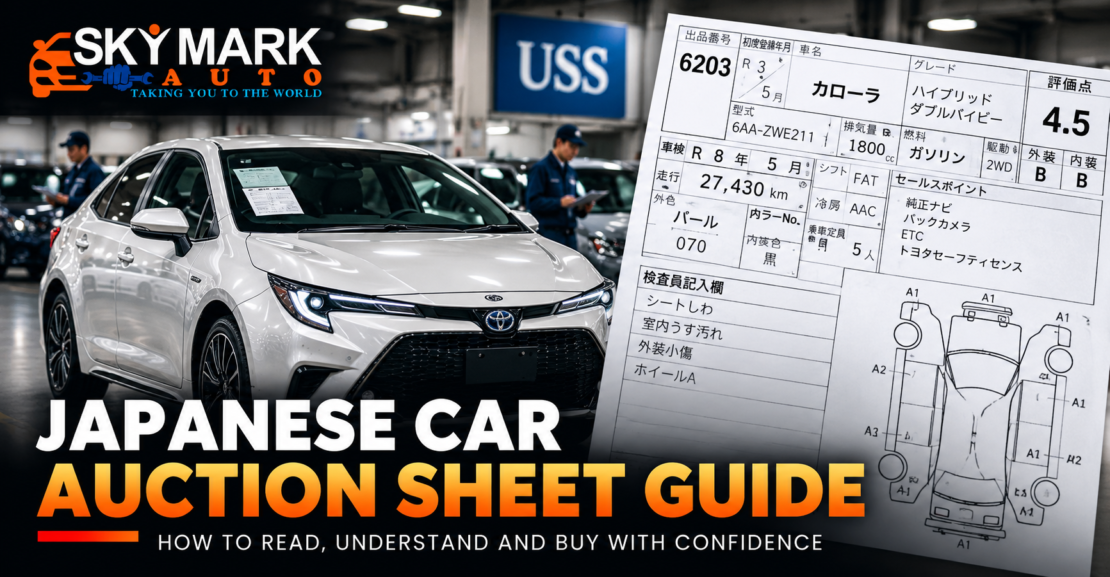
Buying a used vehicle directly from Japan can give overseas buyers access to an enormous selection of cars, from economical daily drivers and family SUVs to luxury vehicles and rare JDM models.
However, there is one obvious challenge.
You may be thousands of kilometres away from the vehicle you want to buy.
You cannot simply walk around the car, inspect the paint, check the interior and take it for a test drive.
This is why the Japanese car auction sheet is so important.
When a vehicle is offered through a Japanese auto auction, an inspection sheet will commonly provide information about the vehicle’s condition at the time of auction. Depending on the auction house, it can show the overall auction grade, mileage, interior condition, scratches, dents, repairs and comments from the auction inspector.
But if you have never seen one before, a Japanese auction sheet can look confusing.
There are numbers, letters, Japanese comments and strange codes such as A1, U2, W2 or XX.
In this guide, we will explain the basics so you can better understand what you are looking at before bidding on a vehicle in Japan.
What Is a Japanese Car Auction Sheet?
A Japanese car auction sheet is a vehicle condition report prepared when a vehicle is listed at an auto auction in Japan.
The exact layout and grading system can vary between auction houses, so an auction grade should never be treated as the only piece of information you need when evaluating a vehicle.
A typical auction sheet may include information such as:
- Make and model
- Model code
- Chassis information
- First registration date
- Mileage
- Engine capacity
- Transmission
- Vehicle equipment
- Overall auction grade
- Interior condition
- Exterior condition
- Body damage diagram
- Inspector’s comments
For an overseas buyer, this information can be extremely useful because it provides another way to evaluate a vehicle before deciding whether to bid.
At Sky Mark Auto, we recommend looking at the complete picture: the auction sheet, available photographs, inspection information, vehicle history where available, your budget and the intended use of the vehicle.
Understanding Japanese Auction Grades
One of the first things buyers notice on an auction sheet is the overall grade.
You might see grades such as:
S, 6, 5, 4.5, 4, 3.5, 3, 2, 1, R or RA.
As a general principle, higher numerical grades usually indicate vehicles presented in better overall condition.
However, there is an important point that new buyers often miss:
Auction grading systems are not completely identical across every auction house.
A Grade 4 vehicle at one auction should not automatically be assumed to be identical in condition to every other Grade 4 vehicle.
This is why experienced buyers don’t purchase a car simply because they see a particular grade.
They examine the complete auction sheet.
Grade 5 and Higher
Vehicles receiving very high grades are generally newer and presented in very good condition, although the exact criteria depend on the auction house.
These vehicles may also have relatively low mileage.
Naturally, cleaner and newer vehicles can attract stronger bidding.
Grade 4.5
Grade 4.5 is commonly associated with vehicles in very good overall condition.
There may still be minor imperfections, which is why you should check the body diagram and inspector comments rather than assuming the vehicle is perfect.
Grade 4
Grade 4 vehicles are extremely common targets for buyers looking for a balance between condition and price.
Normal signs of use, scratches or small dents may be present.
A Grade 4 does not mean that the vehicle is free from imperfections.
Grade 3.5
A Grade 3.5 vehicle can still be an interesting purchase.
It may have more noticeable cosmetic wear than a higher-grade vehicle, but that does not automatically make it a bad car.
For buyers working within a particular budget, carefully selected 3.5-grade vehicles may be worth considering.
Again, the individual inspection details matter more than the number alone.
Grade 3 and Below
Lower grades generally indicate that the vehicle requires closer examination.
There may be more significant cosmetic wear, deterioration, modifications or other issues depending on the auction and vehicle.
This doesn’t automatically mean you should reject the vehicle.
Instead, it means you should understand exactly why it received that grade before bidding.
What Do R and RA Mean?
This is one of the most important areas for overseas buyers to understand.
An R or RA-type grade generally indicates repair history, although definitions and grading conventions can vary between auction houses.
That does not automatically mean the vehicle is unsafe or a bad purchase.
Repair history can range considerably in nature and severity.
The important question is not simply:
“Is this an R grade?”
The better questions are:
“What was repaired?”
“Which panels or structural areas were affected?”
“What does the auction inspector say?”
“Is this vehicle suitable for my intended use and destination?”
A properly understood repair-history vehicle can sometimes be attractive to a buyer at the right price, while another buyer may prefer to avoid repaired vehicles entirely.
The key is knowing what you are buying.
Understanding the Body Diagram
Most auction sheets include a diagram showing the vehicle from different angles.
This is where inspectors mark visible exterior imperfections.
You may encounter codes such as:
A – Scratch
U – Dent
W – Repair or paintwork indication
S – Rust
C – Corrosion
X – Panel or part requiring replacement
XX – Panel or part that has previously been replaced
These markings are commonly accompanied by numbers indicating the extent of the issue.
For example, you may see:
A1
A2
A3
Generally, the higher number indicates a more significant defect within that auction’s notation system.
So an A1 may represent a relatively minor scratch while an A3 would normally deserve more attention.
But remember: auction notation can vary.
Do not treat an online code chart as a substitute for understanding the particular auction sheet in front of you.
Why Inspector Comments Are Important
One of the biggest mistakes first-time buyers make is looking only at the grade.
The inspector’s written comments can sometimes tell you much more.
They may mention observations relating to:
- Paint condition
- Interior wear
- Rust or corrosion
- Scratches
- Dents
- Repair marks
- Warning lights
- Mechanical noises
- Underbody condition
- Modifications
- Missing equipment
- Windscreen damage
- Interior stains or odours
The problem for overseas customers is obvious: these comments are normally written in Japanese.
This is where having someone who understands Japanese auction terminology becomes valuable.
A car can look excellent in photographs while the inspector has recorded something important that is difficult to see in the pictures.
Before placing a serious bid, make sure you understand the relevant comments rather than relying on the photographs alone.
Check the Mileage Carefully
Mileage is another major factor affecting both condition and value.
The auction sheet will normally record the vehicle’s displayed mileage, but buyers should still examine all available information carefully.
Don’t assume that lower mileage automatically means a better purchase.
Consider two cars of the same model.
One has 25,000 km but a significantly higher purchase price.
The other has 55,000 km, good inspection information and has clearly been maintained.
Depending on your requirements and budget, the second vehicle could potentially offer better value.
Mileage should therefore be considered together with:
- Vehicle age
- Condition
- Service information where available
- Auction grade
- Inspector comments
- Purchase price
- Intended use
Don’t Ignore the Interior Grade
Buyers naturally concentrate on exterior scratches and dents because those defects are easy to understand.
But interior condition is important too.
Auction sheets may use a separate interior grading system, often involving letters.
A lower interior assessment may reflect issues such as stains, wear, burns, tears, scratches, odours or damage to trim.
This can be particularly important when purchasing:
- Luxury vehicles
- Family vehicles
- Commercial vehicles
- Collector cars
- High-value JDM vehicles
Replacing damaged interior components can sometimes be more difficult and expensive than correcting minor exterior cosmetic defects.
Is a Grade 4.5 Always Better Than a Grade 4?
Not necessarily for every buyer.
Imagine two similar vehicles.
Vehicle A
Grade: 4.5
Mileage: 35,000 km
Purchase price: significantly higher
Vehicle B
Grade: 4
Mileage: 48,000 km
Minor scratches noted
Purchase price: considerably lower
If the minor imperfections on Vehicle B don’t matter to you, it may offer attractive value.
Another buyer looking for the cleanest possible example may prefer Vehicle A.
This illustrates an important principle when buying from Japanese auctions:
Don’t chase the grade. Buy the vehicle that best matches your condition requirements, intended use and budget.
Photos and Auction Sheets Should Be Used Together
An auction sheet is valuable, but it should not necessarily be your only source of information.
When available, review the vehicle photographs alongside the auction report.
Look at:
- Front and rear bumpers
- Both sides of the body
- Wheels
- Interior
- Dashboard
- Seats
- Cargo area
- Engine bay
- Visible underbody areas
Then compare what you see with the markings and comments on the auction sheet.
If something is unclear, ask questions before bidding.
Once a vehicle has been successfully purchased at auction, changing your mind can become expensive or impossible.
Common Mistakes Overseas Buyers Make
Choosing a Car Only Because of the Auction Grade
The grade is useful, but it doesn’t tell the entire story.
Read the complete sheet.
Ignoring Japanese Inspector Comments
A clean-looking vehicle can still have important observations recorded by the inspector.
Get the relevant comments explained or translated.
Looking Only at the Purchase Price
The winning auction price isn’t necessarily the final landed cost.
Depending on the transaction and destination, you may also need to consider auction-related costs, inland transport in Japan, export processing, shipping, insurance where applicable and destination charges or taxes.
Bidding Emotionally
Japanese auctions can move quickly.
Decide your maximum budget before bidding and avoid increasing it simply because you don’t want to lose a particular car.
There will often be another vehicle.
Assuming Every Country Has the Same Import Rules
A vehicle that can be exported from Japan is not automatically eligible for import into every destination.
Age limits, emissions requirements, inspections, taxes, registration rules and other requirements can vary by country.
Always confirm current destination requirements before purchasing.
How Sky Mark Auto Helps Buyers at Japanese Auctions
For an overseas customer, navigating Japanese auctions alone can be difficult.
Sky Mark Auto helps customers source vehicles directly from Japan based on their individual requirements.
Tell our team the:
- Make and model you want
- Preferred year
- Budget
- Mileage range
- Colour preference
- Required specifications
- Destination country
Our team can then help search available inventory and Japanese auction listings matching your requirements.
When auction information is available, we can assist customers in understanding relevant vehicle information before bidding.
Once the right vehicle has been successfully purchased, Sky Mark Auto can also assist with the Japanese side of the export process, including purchase arrangements, documentation, port arrangements and international shipping preparation.
Buying from Japan Should Be About Information, Not Guesswork
The Japanese used-car market offers overseas buyers access to a huge variety of vehicles.
But having thousands of cars to choose from doesn’t mean you should bid blindly.
Understanding the auction sheet helps you make a more informed decision.
Remember the key points:
Don’t judge a vehicle from its auction grade alone.
Check the body diagram.
Understand the inspector’s comments.
Review the mileage and interior condition.
Compare the auction sheet with available photographs.
Know your maximum budget before bidding.
And most importantly, make sure the vehicle meets the import requirements of your destination country before purchasing.
Looking for a Vehicle from Japan?
Whether you’re searching for a Toyota Land Cruiser, Toyota Alphard, Honda CR-V, Nissan Skyline, Subaru WRX, Mazda RX-7 or another Japanese vehicle, Sky Mark Auto can help you source it directly from Japan.
We provide access to Japanese vehicle inventory and auction opportunities and assist international customers throughout the sourcing and export process.
Already know what you want?
Send Sky Mark Auto your vehicle model, preferred year, budget and destination country, and our team can start searching for suitable options.
Sky Mark Auto — Taking You to the World.
Frequently Asked Questions
What is a Japanese car auction sheet?
It is a condition report associated with a vehicle being offered through a Japanese auto auction. Depending on the auction house, it can include information such as mileage, overall grade, interior condition, exterior damage and inspector comments.
Is a Grade 4 Japanese auction car good?
Grade 4 commonly indicates a vehicle in generally good used condition, but grading criteria vary between auction houses. Buyers should review the complete auction sheet and available vehicle information rather than purchasing based only on the grade.
What does R grade mean at a Japanese car auction?
R-type grades generally indicate that the vehicle has repair history. The exact meaning and extent of repairs should be checked using the auction sheet and inspector information.
What does A1 mean on a Japanese auction sheet?
A commonly refers to a scratch, while the number indicates its extent according to the auction’s notation system. Because notation can vary, the specific auction sheet should be interpreted in context.
Can Sky Mark Auto help translate an auction sheet?
Sky Mark Auto can assist customers in understanding auction grades, condition markings, inspection notes and other relevant information when available before a bid is placed.
Can overseas customers buy directly from Japanese car auctions?
Japanese wholesale auctions generally operate through registered members or dealers. Sky Mark Auto assists international customers with vehicle sourcing, auction bidding, purchase arrangements and export preparation from Japan.
What happens if I don’t win the vehicle?
An unsuccessful bid doesn’t mean the search has to end. Sky Mark Auto can continue looking for other vehicles matching your model, year, condition and budget requirements.
By Naveen Chandrasekara | Sky Mark Auto
Published: September 30, 2026 | Updated: September 30, 2026