
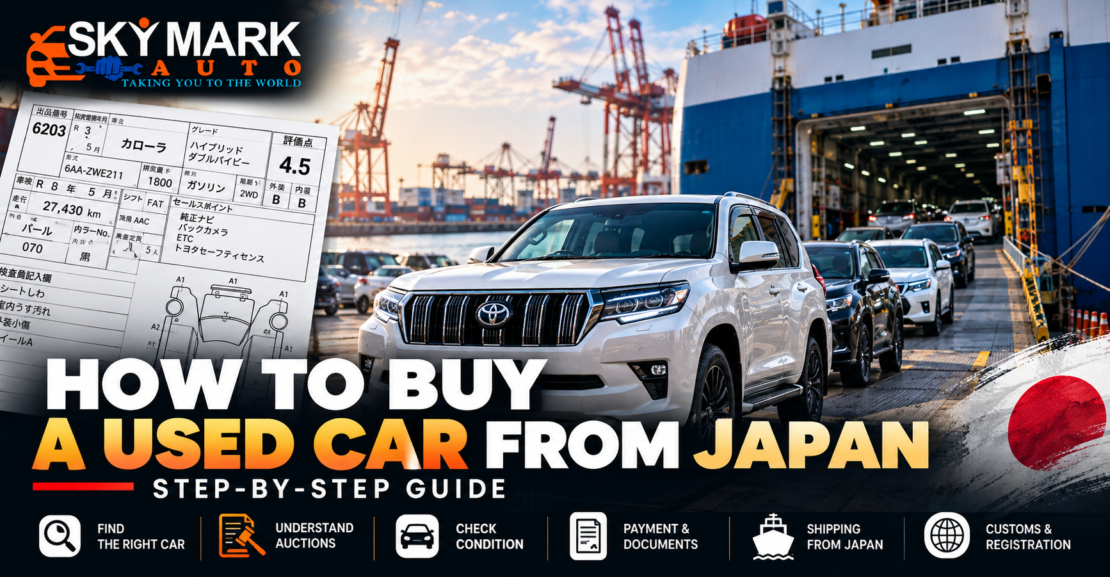
By Naveen Chandrasekara | Founder, Sky Mark Auto
Published: October 1, 2026
Last Updated: October 1, 2026
Buying a used car directly from Japan can be an excellent way to access well-maintained vehicles, unusual specifications, hybrids, commercial vehicles and sought-after JDM models. But if you have never imported a vehicle before, the process can seem complicated.
Where does the car come from? How do you know its real condition? What happens after you pay? Who arranges shipping? And what documents do you need when the vehicle reaches your country?
At Sky Mark Auto, we work from Japan and help overseas customers source and export Japanese vehicles. This guide explains the process from choosing a vehicle through to shipment, while highlighting the checks buyers should make before committing their money.
Why Do Overseas Buyers Choose Used Cars from Japan?
Japan has a huge domestic vehicle market, and buyers can find everything from economical kei cars and family hybrids to vans, SUVs, performance cars and luxury vehicles.
One of the biggest advantages is choice.
Instead of being limited to vehicles already imported by local dealers, buying from Japan can give you access to a much wider selection of makes, models, grades, colours, engine options and specifications.
Japanese vehicles are sold through several channels, including dealer stock, trade-ins and large vehicle auction networks.
However, buying from Japan should never mean simply finding the cheapest car online and sending money.
The important part is buying the right vehicle at the right condition and understanding the complete landed cost before purchase.
Step 1: Check Your Country’s Import Rules Before Choosing a Car
This is the first step—and one buyers sometimes overlook.
Import regulations vary considerably between countries. Depending on your destination, requirements may cover:
- Maximum or minimum vehicle age
- Right-hand-drive or left-hand-drive eligibility
- Emissions standards
- Safety standards
- Pre-shipment inspection
- Import permits
- Duties and taxes
- Vehicle registration requirements
A vehicle that can legally be exported from Japan is not automatically eligible to be imported and registered in every country.
For that reason, you should confirm your destination country’s current regulations before purchasing the vehicle.
This is particularly important if you are considering an older JDM performance car, modified vehicle, commercial vehicle or model that was never officially sold in your country.
Step 2: Decide What Vehicle You Actually Need
Before searching, establish a realistic budget and vehicle specification.
Tell your exporter what matters to you, such as:
Make and model: Toyota Corolla Cross, Suzuki Jimny, Toyota Hiace, Subaru WRX, etc.
Model year: Your country may have age restrictions.
Mileage: Decide whether low mileage is essential or whether you would accept higher mileage for a better price.
Colour: Being flexible can significantly increase your choices.
Grade/specification: Japanese domestic models often have several grades that look similar but have very different equipment.
Budget: Most importantly, specify whether your budget means vehicle price in Japan, FOB price, CIF price or your complete landed budget.
This distinction is important.
A ¥1,000,000 vehicle does not necessarily mean the total cost is ¥1,000,000.
Auction fees, inland transportation, exporter charges, documentation, inspection and international freight may also need to be considered.
Step 3: Dealer Stock or Japanese Car Auction?
There are two common ways overseas customers buy Japanese used vehicles.
Buying a Vehicle Already in Stock
Stock vehicles are generally simpler.
The exporter already has access to the vehicle and can provide photographs, specifications and pricing. Depending on the vehicle, it may also be possible to conduct additional inspections before purchase.
The advantage is that you know exactly which vehicle is available and usually know the purchase price immediately.
Buying Through a Japanese Auto Auction
Auctions offer enormous variety.
Vehicles are entered into Japanese auto auctions by dealers and other sellers, and professional buyers bid on them.
Rather than asking, “What is the cheapest car today?”, a better approach is to establish your requirements and maximum bid before the auction.
If the price goes beyond your sensible limit, let the vehicle go.
There will usually be another opportunity.
Step 4: Understand the Auction Sheet Before Bidding
If you are buying an auction vehicle, the auction sheet is one of the most useful pieces of information available before bidding.
It can include information such as:
- Vehicle model and chassis details
- Registration year
- Odometer reading
- Auction grade
- Interior grade
- Equipment
- Inspector comments
- Body damage diagram
- Repair history indications
But an auction sheet should not be reduced to a single number.
For example, two cars carrying a similar overall auction grade can still differ in scratches, dents, interior condition, corrosion, previous repairs and mechanical comments.
You should look at the whole inspection report, not just the headline grade.
We covered this subject in detail in our previous How to Read a Japanese Car Auction Sheet guide.
Step 5: Check the Vehicle Carefully Before You Buy
This is where having someone in Japan who understands the sourcing process becomes valuable.
Depending on the sales channel and access available, useful checks may include:
- Auction inspection information
- Additional vehicle photographs
- Chassis number
- Mileage information
- Warning lights
- Exterior damage
- Interior wear
- Corrosion
- Tyre condition
- Modifications
- Previous repair information
- Engine or transmission comments
No used vehicle should be represented as perfect simply because it comes from Japan.
Cars are mechanical products, and condition varies from vehicle to vehicle.
A trustworthy buying process should help you understand known defects before you decide whether the vehicle is worth purchasing.
Step 6: Set a Maximum Auction Bid
One of the easiest mistakes to make at auction is emotional bidding.
Suppose you find exactly the colour and specification you have been searching for. Once bidding starts, it can be tempting to keep increasing your offer.
Instead, establish your maximum price beforehand.
That maximum should take into account not only the hammer price but also the additional costs involved in getting the vehicle from Japan to your destination.
If the bidding exceeds your maximum, walking away can be the smartest decision.
Another suitable vehicle may appear tomorrow or next week.
Step 7: Understand FOB and CIF Pricing
You will frequently encounter the terms FOB and CIF when importing vehicles.
FOB – Free on Board
In simplified terms, an FOB price generally covers the vehicle and the agreed costs necessary to get it exported and loaded for shipment from Japan, according to the seller’s quoted terms.
International freight and destination-side costs are generally outside an FOB quotation.
CIF – Cost, Insurance and Freight
CIF generally includes the agreed cost of the vehicle, marine insurance and freight to the named destination port.
However, CIF does not mean “everything included until I can drive the car.”
Destination charges, customs duties, taxes, clearance, registration and other local expenses may still apply.
Always ask exactly what is included in a quotation rather than relying only on the words FOB or CIF.
Step 8: Payment and Documentation
Once you agree to purchase a vehicle, the exporter should provide appropriate commercial documentation and payment instructions.
Before transferring money, verify:
- Seller/exporter company name
- Bank account details
- Vehicle details
- Chassis number where applicable
- Invoice amount
- Agreed shipping terms
Be particularly careful with unexpected emails telling you that bank details have suddenly changed.
If payment instructions change, independently confirm them with the company using a communication method you already trust.
This simple precaution can help protect buyers from payment-redirection scams.
Step 9: Preparing the Vehicle for Export
After purchase, several things need to happen in Japan before the vehicle leaves the country.
The exact process depends on the vehicle and destination, but it can include deregistration/export documentation, inland transportation to the relevant port, required inspections, shipping arrangements and preparation of export documents.
For some destinations, a mandatory pre-shipment inspection or certification may also be required.
This is another reason destination requirements should be established before the vehicle is purchased rather than after it reaches the port.
Step 10: Shipping from Japan
Vehicles are commonly exported using either RoRo or container shipping.
RoRo Shipping
RoRo means roll-on/roll-off.
The vehicle is driven onto a specialised vessel in Japan and driven off at the destination port.
For normal running passenger vehicles, RoRo can be a practical shipping method where the required route is available.
Container Shipping
Vehicles can also be transported inside shipping containers.
Container shipping may be appropriate depending on the destination, vehicle type, shipping route and customer’s requirements.
Freight rates and vessel availability change, so buyers should obtain a current quotation rather than relying on an old shipping price found online.
Step 11: Receive Your Shipping Documents
The documentation required depends on the destination and transaction.
Typical export/shipping paperwork can include documents such as:
- Commercial invoice
- Export certificate
- Bill of lading
- Inspection certificate when required
- Other destination-specific documentation
Keep electronic copies of all documents and make sure your customs agent or clearing agent receives what they need before the vehicle arrives.
Missing documentation can cause unnecessary delays and additional port costs.
Step 12: Customs Clearance and Registration
Once the vehicle arrives, the import process moves from Japan to your destination country.
Normally, the buyer or appointed clearing agent completes customs clearance, pays applicable duties and taxes, collects the vehicle and completes local registration procedures.
This is where the final cost of importing becomes important.
Before buying, try to calculate:
Vehicle + Japan-side costs + freight + insurance + import duty/tax + clearance + registration + local transport
That figure gives you a much better basis for comparing an imported vehicle with one already available in your local market.
What Should You Ask a Japanese Car Exporter?
Before purchasing, don’t be afraid to ask questions.
You should be able to understand what you are buying, the known condition of the vehicle, the basis of the quoted price, what services are included and what happens after payment.
Be cautious if you are pressured to transfer money immediately without adequate vehicle information.
The cheapest quotation is not always the best deal.
A slightly more expensive vehicle with clearer history, better condition and proper documentation can ultimately cost less than repairing a poor-quality purchase.
Can Sky Mark Auto Help Source a Specific Vehicle?
Yes.
If you already know what you want, send Sky Mark Auto the make, model, year range, preferred colour/specification, mileage preference, destination country and approximate budget.
We can then look at suitable sourcing options in Japan and help you understand the purchasing and export process.
Whether you are looking for a practical Japanese vehicle, commercial van, SUV or a special JDM model, the objective should be the same: buy based on condition and value—not photographs alone.
Frequently Asked Questions
Is it safe to buy a used car directly from Japan?
It can be a reliable way to purchase a vehicle when you deal with a legitimate exporter, verify payment details, understand the vehicle’s condition and follow your country’s import requirements. Never transfer money solely because an online advertisement looks attractive.
Can I personally bid at Japanese car auctions?
Major dealer auctions are generally trade-oriented rather than ordinary retail marketplaces. Overseas buyers commonly work through an eligible Japanese auction member or exporter who bids on their behalf.
What does an auction grade of 4 or 4.5 mean?
Auction grades provide a useful indication of condition, but grading systems and individual vehicles vary. The grade should always be considered together with inspector comments, the damage map, mileage, interior grade and available photographs.
How long does shipping from Japan take?
There is no single shipping time. It depends on the destination port, vessel schedule, route, transshipment requirements and current shipping availability. Ask for the latest sailing information when you are ready to ship.
Is CIF the final price I pay?
Usually not. A CIF quotation relates to cost, insurance and freight under the agreed terms. Your destination may still charge import duty, taxes, port/clearance fees, registration costs and other local expenses.
Can Sky Mark Auto source a vehicle that is not currently in stock?
Yes. Customers can provide their desired vehicle specifications and budget so suitable sourcing opportunities in Japan can be considered.
Looking for a Vehicle from Japan?
Buying directly from Japan doesn’t need to feel complicated.
Sky Mark Auto can assist overseas customers with Japanese vehicle sourcing, auction purchasing and export arrangements.
Send us the vehicle you are looking for together with your destination country and budget, and we can help you explore suitable options available in Japan.
Contact Sky Mark Auto today to start your Japanese vehicle search.
About the Author
Naveen Chandrasekara — Founder, Sky Mark Auto
Naveen Chandrasekara is the founder of Sky Mark Auto and is based in Japan. His work includes Japanese vehicle sourcing and export, helping overseas customers navigate the process of finding and purchasing vehicles from the Japanese market.