
By Naveen Chandrasekara | Sky Mark Auto
Published: October 4, 2026
When buying a vehicle from Japan, you may see terms such as FOB, CFR, C&F and CIF on quotations and invoices.
But what do these terms actually mean?
Understanding FOB vs CIF car shipping is important because the shipping term affects who arranges the ocean freight, who pays certain transportation costs, and who arranges marine insurance.
At Sky Mark Auto, we believe overseas buyers should clearly understand what they are paying for before purchasing a vehicle from Japan.
In this guide, we’ll explain FOB, CFR and CIF in simple terms.
What Are FOB, CFR and CIF?
FOB, CFR and CIF are international trade terms used to define certain responsibilities between sellers and buyers.
They form part of the Incoterms® rules published by the International Chamber of Commerce (ICC). The current version is Incoterms® 2020. ICC – International Chamber of Commerce
For vehicles transported by sea, the three terms generally mean:
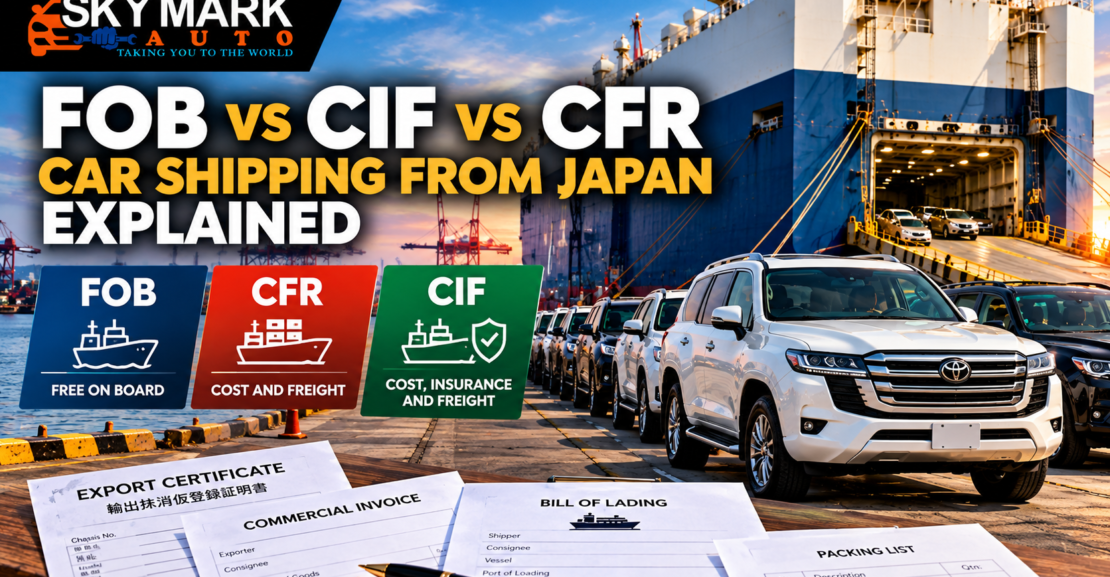
FOB — Free On Board
CFR — Cost and Freight
CIF — Cost, Insurance and Freight
You may also commonly see C&F used in the vehicle export industry to describe a cost-and-freight quotation. The formal Incoterms® term is CFR.
Let’s look at each one.
What Does FOB Mean When Buying a Car From Japan?
FOB means Free On Board.
Under FOB, the seller delivers the vehicle on board the vessel nominated by the buyer at the agreed Japanese port of shipment.
Once the vehicle is on board, risk transfers to the buyer under the Incoterms® FOB rule. The buyer is responsible for the main ocean freight arrangements and costs from that point onward. ICC WBOライブラリー
JETRO’s Japanese used-vehicle export guidance specifically notes that under an FOB contract, the buyer books the vessel. ジェトロ
A simple FOB example
Imagine you purchase a Japanese vehicle with:
FOB Yokohama Price: ¥1,500,000
This does not automatically mean ¥1,500,000 is the total cost of getting the vehicle to your country.
You still need to consider expenses such as ocean freight, insurance if desired, destination-port charges, customs clearance, import duties/taxes and local transportation, depending on your country and arrangements.
Therefore, when comparing vehicle prices online, always check whether the advertised price is an FOB price or a price including freight.
What Does CFR Mean?
CFR means Cost and Freight.
Under CFR, the seller arranges and pays for the ocean freight required to transport the vehicle to the named destination port.
For example:
CFR Colombo
CFR Port of Spain
CFR Georgetown
This can make the purchasing process easier for an overseas buyer because the Japanese exporter arranges the main sea transportation.
However, there is an important point many first-time buyers misunderstand:
Paying the freight does not mean the seller carries the shipping risk all the way to the destination.
Under CFR, risk generally transfers from the seller to the buyer when the vehicle has been placed on board the vessel at the port of shipment. ICC WBOライブラリー
Does CFR Include Marine Insurance?
No.
Under CFR, the seller is not required to purchase marine cargo insurance for the buyer.
ICC specifically distinguishes CFR from CIF on this point. ICC WBOライブラリー
Therefore, if you purchase a vehicle under CFR terms, you should understand whether you need to arrange your own marine insurance.
What Does CIF Mean?
CIF means Cost, Insurance and Freight.
Under CIF, the seller arranges and pays for:
The goods + main ocean freight + specified marine insurance
to the named destination port.
This can be convenient for overseas buyers because freight and insurance arrangements are handled as part of the transaction.
However, another important misconception needs to be avoided.
CIF does not mean the seller carries all risk until arrival
Under Incoterms® 2020, risk still generally transfers when the goods are on board the vessel at the port of shipment.
The difference is that under CIF, the seller is also required to arrange insurance covering the buyer’s transit risk.
ICC also notes that the standard insurance requirement under CIF is minimum cover, unless the parties agree to greater protection. ICC WBOライブラリー
Therefore, buyers purchasing expensive vehicles should check exactly what the insurance policy covers.
FOB vs CFR vs CIF — Simple Comparison
Here is an easy way to understand the three:
| FOB | CFR | CIF | |
|---|---|---|---|
| Vehicle supplied by seller | ✓ | ✓ | ✓ |
| Export arrangements | ✓ | ✓ | ✓ |
| Loaded on vessel | ✓ | ✓ | ✓ |
| Ocean freight paid/arranged by seller | No* | ✓ | ✓ |
| Marine insurance arranged by seller | No | No | ✓ |
| Destination import clearance | Buyer | Buyer | Buyer |
| Import duties/taxes | Buyer | Buyer | Buyer |
*Subject to the actual contract and arrangements between the parties.
Incoterms® define responsibilities concerning delivery, risk and costs, but they do not replace the complete sales contract between buyer and seller. ICC WBOライブラリー
Example: Buying a Toyota From Japan
Let’s use a simple example.
Suppose you purchase a Toyota from Japan.
Option 1 — FOB
Vehicle FOB price:
¥1,500,000
You or your shipping agent arrange the ocean freight separately.
Option 2 — CFR
Vehicle and export price:
¥1,500,000
Ocean freight:
¥180,000
CFR price:
¥1,680,000
The exporter arranges the main sea transportation to the named destination port.
Option 3 — CIF
Vehicle and export price:
¥1,500,000
Ocean freight:
¥180,000
Marine insurance:
¥15,000
CIF price:
¥1,695,000
These numbers are only examples—the actual freight and insurance costs depend on the vehicle, shipping method, destination and current shipping rates.
Does CIF Include Import Tax?
Normally, no.
This is another common misunderstanding.
CIF does not normally mean that all costs after the vehicle reaches your country are included.
The buyer can still be responsible for items such as:
- Import duties
- VAT/GST or other local taxes
- Customs clearance
- Port handling charges
- Storage charges where applicable
- Registration
- Compliance or inspection
- Local transportation
Under CIF, the seller is not responsible under the Incoterms® rule for clearing the vehicle for import or paying the destination country’s import duties. ICC WBOライブラリー
Always check the import regulations and charges in your country before purchasing a vehicle.
Which Shipping Term Should a Car Buyer Choose?
There isn’t one shipping term that suits every transaction.
FOB can make sense when the buyer has their own shipping arrangements or freight forwarder.
CFR can be convenient when the buyer wants the Japanese exporter to arrange ocean freight.
CIF adds seller-arranged marine insurance to the freight arrangement.
The important thing is not simply choosing the cheapest quotation.
You should understand exactly what is included and excluded.
Don’t Compare FOB and CIF Prices Directly
Imagine two exporters advertise the same type of vehicle:
Exporter A: ¥1,500,000 FOB
Exporter B: ¥1,680,000 CIF
At first glance, Exporter A appears ¥180,000 cheaper.
But that comparison is incomplete because one quotation may exclude freight and insurance while the other includes them.
When comparing Japanese vehicle quotations, compare them on the same shipping basis.
What Should You Check Before Paying?
Before sending payment for a vehicle from Japan, confirm:
- Vehicle chassis number
- Vehicle price
- Shipping term
- Japanese port of shipment
- Destination port
- Ocean freight
- Marine insurance and coverage, if applicable
- Inspection requirements
- Documentation
- Destination charges
- Import duties and taxes
You should also confirm whether your destination country requires a pre-shipment inspection.
JETRO notes that Japanese used-car exports can require documentation including the invoice, packing list, Bill of Lading, export deregistration documentation and a pre-shipment inspection certificate where required by the buyer/destination arrangements. ジェトロ
Understand Your Japanese Car Export Documents
Shipping terms are only one part of importing a vehicle.
You will also encounter documents such as the:
Export Certificate
Commercial Invoice
Bill of Lading
Packing List
Inspection Certificate
We explained these documents in our previous guide:
Japanese Car Export Documents Explained: What Every Overseas Buyer Needs to Know
Japan Customs also confirms that registered vehicles intended for export must go through the applicable registration-deletion/export procedure before export. 税関総合情報
Buying Your First Car From Japan?
If you’re new to Japanese vehicle imports, we also recommend reading:
How to Buy a Used Car From Japan – Complete Guide for Overseas Buyers
And if you’re considering purchasing through a Japanese vehicle auction:
How to Read a Japanese Car Auction Sheet
Together, these guides will help buyers understand the vehicle, auction condition, documentation and shipping process before purchasing.
Buy and Export Japanese Vehicles With Sky Mark Auto
Sky Mark Auto helps customers around the world purchase and export vehicles directly from Japan.
We can assist with:
- Japanese vehicle sourcing
- Japanese auto auctions
- Auction sheet checking
- Vehicle purchasing
- Export documentation
- Pre-shipment arrangements
- Shipping coordination
- International customer support
Whether you’re searching for a family vehicle, SUV, commercial vehicle, luxury car, sports car or JDM vehicle, our team can help you source suitable vehicles from Japan.
Contact Sky Mark Auto
Looking for a vehicle from Japan?
Contact Sky Mark Auto with the make, model, year, budget and destination country you’re looking for.
We’ll help you understand the vehicle price and available export/shipping arrangements before purchasing.
Sky Mark Auto — Japanese Vehicles for the World
Quality. Trust. Performance.